Artificial intelligence has rapidly transformed the digital content landscape. One of the most innovative advancements is the ability to generate videos directly from written ideas. Instead of relying on cameras, actors, or complex editing tools, creators can now type a description and allow artificial intelligence to turn that idea into a visual story.
This technology is becoming increasingly important for marketers, educators, creators, and businesses. Understanding how does text to video AI work helps explain how machines interpret written language and transform it into dynamic visual content.
The Rise of AI-Powered Video Creation
Video production traditionally required multiple stages such as scripting, recording, editing, and post-production. These steps often demanded significant time, equipment, and technical expertise.
Modern AI tools simplify this process by automating video creation. Users can write a short prompt describing a scene, concept, or message, and the system generates visuals that match the description.
As more platforms introduce these capabilities, curiosity around how does text to video AI work continues to grow among creators and technology enthusiasts.
How AI Understands Written Ideas
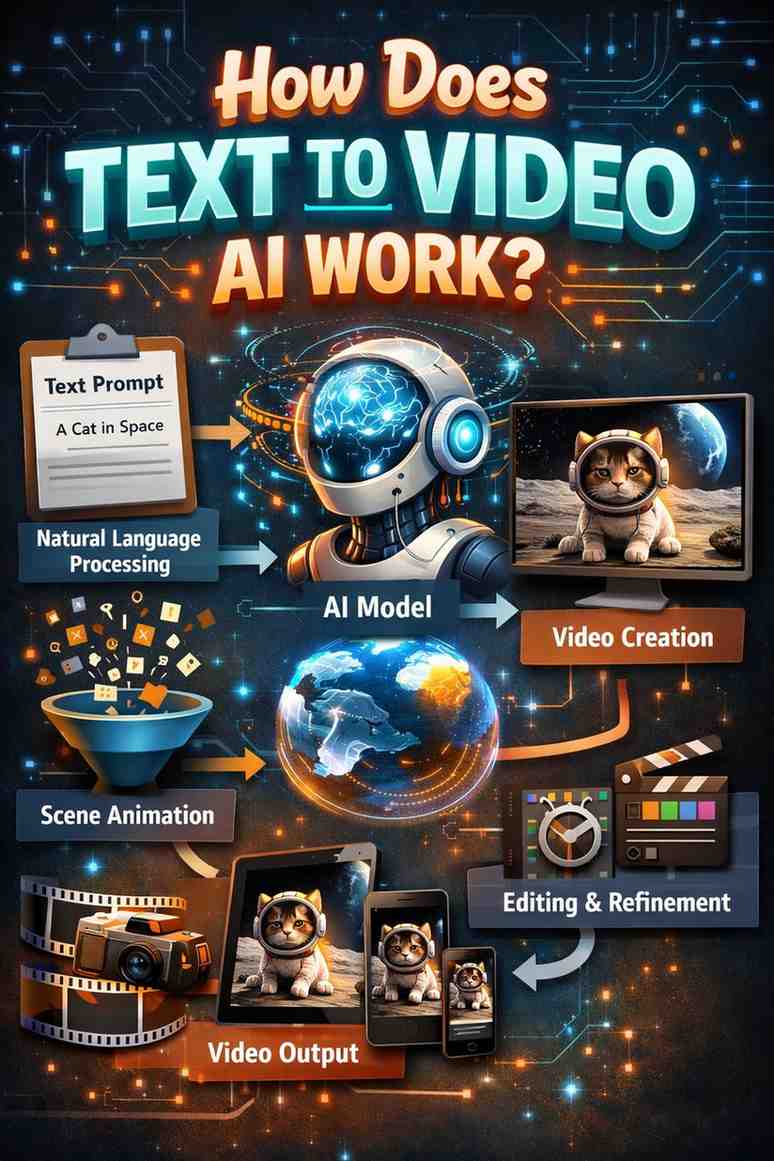
The first step in converting text into video involves interpreting the written prompt. AI systems use advanced language models to understand the meaning, context, and structure of the input text.
When a user describes a scenario, the AI analyzes key elements such as objects, actions, environments, and emotions. These elements are translated into visual instructions that guide the video generation process.
This stage demonstrates an essential part of how does text to video AI work, as the system must first understand human language before producing any visual output.
Converting Language into Visual Concepts
Once the text has been analyzed, the AI begins transforming the words into visual concepts. It predicts what each part of the description should look like based on patterns learned during training.
For example, if a prompt describes a “city street at night with glowing lights and moving traffic,” the system identifies objects such as buildings, vehicles, lights, and roads. It then generates visuals representing these elements.
The ability to translate written descriptions into scenes is central to understanding how does text to video AI work in real-world applications.
Core Technologies Behind AI Video Generation
Several advanced technologies work together to convert text prompts into videos. These systems combine language understanding with visual generation models.
Key Technologies Used in Text-to-Video AI
-
Natural language processing
This technology helps AI understand grammar, meaning, and relationships between words in a prompt. -
Generative AI models
Generative models create new images and video frames based on patterns learned from training data. -
Computer vision systems
Computer vision allows AI to understand shapes, objects, motion, and visual structure within generated scenes.
These technologies form the foundation for how does text to video AI work across many modern AI platforms.
From Generated Images to Moving Videos
After visual elements are generated, the AI begins assembling them into a video sequence. This involves creating multiple frames that represent gradual motion or scene progression.
Each frame must maintain consistency in lighting, object placement, and perspective. The AI predicts how elements should move or change over time, allowing the frames to form smooth animations.
This stage highlights another important aspect of how does text to video AI work, where individual images are combined into a cohesive video.
The Process of AI Video Creation
AI video generation follows a structured workflow that transforms text prompts into completed visual clips.
Steps in the AI Video Generation Process
-
Text analysis and scene interpretation
The AI analyzes the prompt to understand the story, objects, and actions involved. -
Frame generation
Visual frames are created to represent the described environment and characters. -
Motion and sequencing
Frames are arranged and animated to create continuous motion within the video.
This step-by-step process illustrates how does text to video AI work behind the scenes.
Training AI Models with Large Data Sets
AI models cannot generate realistic visuals without extensive training. Developers train these systems using massive datasets that include images, videos, and descriptive text.
By studying millions of examples, the AI learns how objects look, how scenes change over time, and how actions appear visually. This training enables the system to recreate similar visuals when given a text prompt.
The training phase is crucial for improving the accuracy and quality of generated videos.
Applications of Text-to-Video Technology
Text-to-video AI is rapidly gaining popularity across multiple industries. Businesses and creators are exploring its potential for producing visual content quickly and efficiently.
Marketing teams can generate promotional videos without large production budgets. Educators can create visual lessons that make complex topics easier to understand. Content creators can experiment with storytelling ideas by simply writing descriptive prompts.
Understanding how does text to video AI work helps organizations discover new ways to communicate ideas visually.
Benefits for Content Creators and Businesses
The growing popularity of AI video generation is largely due to its efficiency and accessibility. These tools significantly reduce the time and resources required to produce video content.
Instead of spending hours editing footage, creators can focus on writing clear prompts and refining their ideas. AI handles the complex technical tasks involved in generating visuals.
As a result, more individuals and businesses can participate in video production, even without professional filmmaking experience.
Challenges in AI Video Generation
Although the technology is advancing rapidly, text-to-video AI still faces several challenges. Generating long videos with complex movements or detailed characters can be difficult.
AI systems may occasionally produce visuals that do not fully match the prompt or contain inconsistencies between frames. Developers are actively working to improve these models by expanding datasets and refining algorithms.
Despite these challenges, progress in AI research continues to enhance the capabilities of text-to-video systems.
The Future of AI-Generated Video Content
The future of video creation is closely tied to artificial intelligence. As computing power increases and machine learning models become more sophisticated, AI-generated videos will likely become more realistic and customizable.
Future tools may allow users to generate full-length films, advertisements, or educational content simply by describing their ideas in text form.
Understanding how does text to video AI work today provides insight into the powerful creative possibilities that artificial intelligence may unlock in the coming years.
Conclusion
Artificial intelligence is revolutionizing the way visual content is produced. Text-to-video technology allows creators to turn simple written ideas into engaging videos using advanced machine learning models.
By combining natural language processing, generative AI, and computer vision, these systems can interpret text prompts and generate dynamic visual scenes. Learning how does text to video AI work helps reveal the complex technology that powers this innovative content creation method.
As AI tools continue to evolve, they are likely to play an increasingly important role in digital storytelling, marketing, and education, making video production more accessible than ever before.